

From cotton mills to cutting-edge tech, the North West of England remains a cornerstone of the UK economy – now turbocharged by growing Chinese investment and innovation
The North West of England has always been a land of reinvention. Once the beating heart of the Industrial Revolution, its cotton mills and shipyards powered Britain to global dominance. Today, this resilient region has evolved into a modern economic juggernaut, with a gross value added (GVA) of £196.8 billion in 2022. It’s the second-largest regional economy outside London and the South East, a powerhouse of advanced manufacturing, life sciences, digital innovation, and green energy. What’s more, its strategic importance is increasingly tied to international partnerships – none more significant than its deepening ties with China. From nuclear energy to electric vehicles, Chinese firms are leaving an indelible mark on the North West, helping to shape its future as a global player.

The industrial diversity of the North West of England is staggering. Aerospace giants like BAE Systems churn out cutting-edge defence technology in Samlesbury and Warton, employing thousands of people and generating billions annually for the UK’s export market. Just across the border in Broughton, Airbus’s wing-manufacturing site supports another 6,000 jobs, its production lines humming with orders for next-generation aircraft. Meanwhile, the automotive sector is racing toward a greener future. Vauxhall’s Ellesmere Port plant, retooled in 2023 to produce electric vans, now sustains 1,200 jobs, while Jaguar Land Rover’s Halewood facility in Merseyside has fully transitioned to electric vehicle production, adding 800 new positions in the past year alone.
But it’s not just traditional industries driving growth. The North West is emerging as a leader in life sciences and digital technology, bolstered by world-class universities and a knack for attracting global investment. Chinese companies, in particular, have taken notice, pouring billions into the region and forging partnerships that promise to redefine its economic landscape.
Life sciences and innovation: A prescription for progress
In Cheshire, the sprawling Macclesfield campus of AstraZeneca stands as a testament to the North West’s prowess in life sciences, producing medicines that reach over 120 countries. Nearby, Alderley Park has morphed from a single-tenant pharma site into a buzzing biotech hub hosting over 200 companies.
Manchester, too, is a hotbed of medical innovation. The city’s ‘Science Corridor,’ anchored by the University of Manchester, is a global leader in advanced materials like graphene and pioneering cancer research. The £400 million Health Innovation Campus, set to open fully in late 2025, is already creating 3,000 jobs and fostering collaborations with firms worldwide. Chinese pharmaceutical companies, such as Sinopharm, have expressed interest in joint ventures here, eyeing the region’s research capabilities to accelerate drug development.
Digital dynamism: The North West tech boom
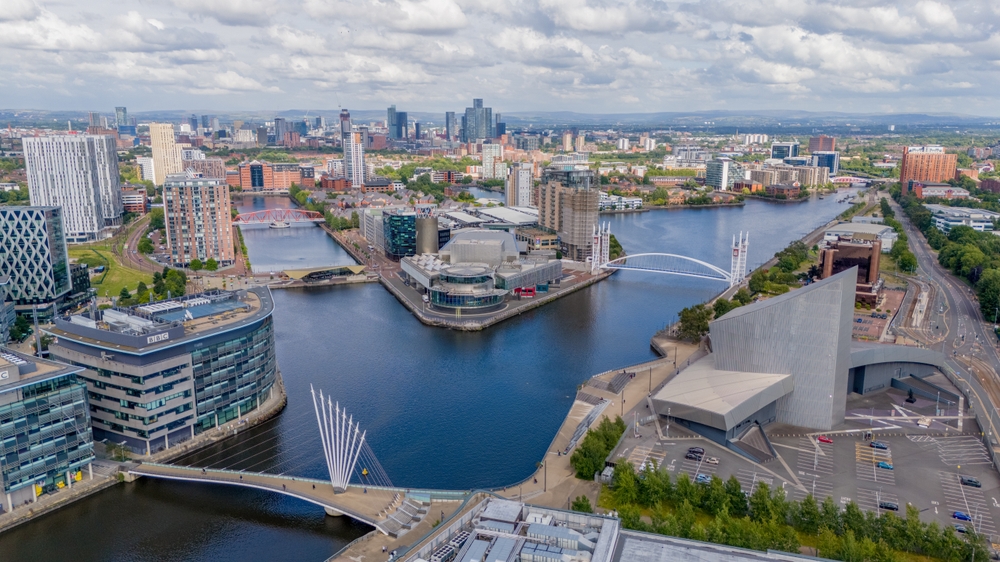
If life sciences are the North West’s brain trust, its digital sector is the beating pulse. Manchester has cemented its status as Europe’s fastest-growing tech hub outside London, with the Greater Manchester Combined Authority reporting a £5.5 billion annual contribution to the economy in 2024. MediaCityUK in Salford, now a £1.2 billion creative and digital quarter, employs 8,000 people and hosts giants like the BBC and ITV alongside a thriving startup scene. In cybersecurity, AI, and gaming, the region is punching above its weight, home to firms like NCC Group and Team17.
Liverpool’s digital renaissance is equally compelling. The Baltic Triangle, a former industrial wasteland, now teems with tech startups and creative studios, generating £300 million annually, according to Liverpool City Council. The Liverpool Film Office, meanwhile, has turned the city into a Hollywood darling, raking in £30 million in 2024 from productions like The Batman. Chinese tech titan Huawei has taken note, employing a growing number of people at its Manchester R&D centre, where it collaborates with the University of Manchester on graphene applications and 5G infrastructure, a partnership that’s yielded 15 patents filed in the UK since 2022.
Green energy: Powering a sustainable future
The North West of England is also at the forefront of the UK’s green revolution. Off the Cumbrian coast, the Walney Extension offshore wind farm – still the world’s second-largest – powers 650,000 homes with its 659 MW capacity, per Ørsted’s 2025 update. The £3 billion HyNet North West project, meanwhile, is on track to launch the UK’s first low-carbon hydrogen network by 2027, slashing regional CO₂ emissions by 12 million tonnes annually by 2030. Nuclear energy remains a cornerstone, with Sellafield in Cumbria employing 11,000 people and managing the UK’s nuclear legacy.
China’s footprint in this sector is unmistakable. China General Nuclear (CGN) holds a 33.5% stake in the Hinkley Point C project and has its sights on further nuclear developments in the North West, including the proposed Moorside plant near Sellafield. If approved, Moorside could generate 3,200 MW, enough to power 6 million homes, and create 20,000 construction jobs, per a 2024 government feasibility study. Chinese wind giant Goldwind is also in talks to supply turbines for future offshore projects in the Irish Sea, capitalizing on the region’s renewable potential.
China’s economic imprint: A £2.5 billion boost
Chinese investment in the North West has surged in recent years, drawn by its industrial heritage and strategic position.
Trade between the North West and China hit £8.4 billion in 2024, up 12% from the previous year, according to HM Revenue & Customs data, with exports like machinery and pharmaceuticals leading the charge.
A 2025 report by the China-Britain Business Council (CBBC) pegs the annual economic contribution of Chinese firms in the region at £2.5 billion, supporting 15,000 jobs. Beyond Huawei’s tech ventures, electric vehicle leader BYD has rolled out 300 electric buses across Liverpool and Manchester since 2022, cutting urban emissions by an estimated 10,000 tonnes annually, per Transport for Greater Manchester. Ping An, the Chinese insurance behemoth, has partnered with Manchester’s fintech ecosystem, investing £150 million in startups like OakNorth and Monzo since 2023.
Government backing and visionary leaders
The UK government is doubling down on the region’s potential. The Northern Powerhouse Investment Fund has facilited £1.2 billion of funding into North West businesses since 2017, while the Mersey Gateway Freeport, launched in 2024, offers tax breaks that have lured £800 million in foreign direct investment, per the Department for Business and Trade. Henri Murison, Chief Executive of the Northern Powerhouse Partnership, is a vocal advocate for more. “The only way to create better paid jobs and with it higher living standards is to bring private sector jobs to this part of the country and I think we have a government now with a growth mission who has every intention of seeking to pursue that agenda with real vigour,” he said in an interview with The Northern Echo.
Greater Manchester Mayor Andy Burnham shares that ambition. “Our goal is to make Greater Manchester a top European destination for business and innovation,” he declared at a 2025 economic summit, spotlighting projects like the £1.5 billion Atom Valley advanced manufacturing hub, which broke ground in January. Together, these efforts signal a region on the cusp of a new golden age.
The Road Ahead: A UK-China Partnership in the Making
The North West’s future shines brightest where UK ingenuity meets Chinese scale. In renewable energy, firms like CGN and Goldwind could turbocharge offshore wind and hydrogen projects, while in life sciences, collaborations with Chinese giants like Fosun Pharma could fast-track breakthroughs in precision medicine. Aerospace offers another frontier—imagine BAE Systems partnering with China’s COMAC to crack new markets in Asia.
For investors, the North West is a goldmine of opportunity. With its blend of heritage and innovation, bolstered by £2.5 billion in Chinese capital and counting, the region is poised to lead the UK—and perhaps the world—into a new era of industrial and technological dominance. Its best days, as the numbers and ambition suggest, are still ahead.