

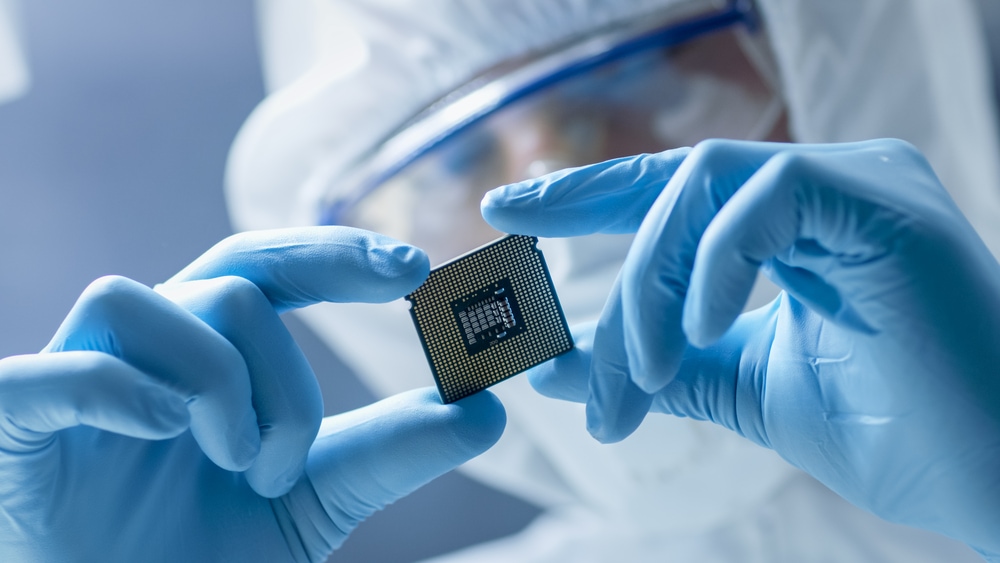
China’s semiconductor industry is rapidly advancing, driven by state-backed initiatives and domestic innovation
China’s semiconductor sector has emerged as a cornerstone of its technological ambition, propelled by significant government investment and a strategic push for self-sufficiency. In 2024, the industry was valued at £134.2 billion, with projections indicating a compound annual growth rate (CAGR) of 7.8% from 2025 to 2034, potentially reaching £283.7 billion by 2034. This growth reflects China’s determination to reduce reliance on foreign chips, which accounted for 83% of its £185.5 billion chip consumption in 2020, and to establish itself as a global leader in semiconductor innovation. The sector’s rapid development, driven by advancements in artificial intelligence (AI), 5G, and electric vehicles (EVs), positions China at the forefront of the global tech race, though geopolitical tensions and technological gaps present significant challenges.
China’s semiconductor industry began in earnest during the 1980s, with early efforts like Project 908 and Project 909 aimed at building domestic capabilities. These initiatives, including partnerships with foreign firms like NEC, faced setbacks due to outdated technologies and global market downturns. A pivotal shift occurred in 2014 with the National Integrated Circuit (IC) Industry Investment Fund, or “Big Fund,” which injected £17.6 billion initially, followed by £23.3 billion in 2019 and £36.8 billion in 2023. The “Made in China 2025” strategy set ambitious targets of 40% self-sufficiency by 2020 and 70% by 2025, though the actual figure reached only 30% by 2025, underscoring the complexity of achieving technological autonomy. Despite this, China’s 53.7% share of global chip consumption in 2020 highlights its position as the world’s largest semiconductor market.

Key players dominate China’s semiconductor landscape. Semiconductor Manufacturing International Corporation (SMIC), the country’s largest foundry, reported £9.77 billion in revenue in Q1 2024, a 19.7% year-on-year increase, making it the world’s second-largest pure-play foundry behind Taiwan’s TSMC. SMIC’s production of 7-nanometer chips, such as the Kirin 9000S for Huawei’s Mate 60 Pro, demonstrates its ability to innovate despite U.S. export controls. “SMIC is at most only a few years behind Intel and Samsung,” noted industry analyst Dylan Patel, highlighting its progress in advanced node manufacturing. Hua Hong Semiconductor, the second-largest Chinese chipmaker, holds a 2.6% global market share, focusing on mature node chips. HiSilicon, a Huawei subsidiary, designs advanced chips like the Kirin series, while Yangtze Memory Technologies Corporation (YMTC) has achieved a 5% global market share in NAND flash memory, with plans to surpass 10% by 2027. Other notable firms include Hygon Information Technology, producing x86-based CPUs, and Loongson Technology, developing MIPS-compatible microprocessors for domestic applications.
Opportunities for partnerships are abundant, particularly in mature node manufacturing and emerging technologies. China’s dominance in EVs, with 35 million vehicles projected for 2025, drives demand for power management and sensor chips, creating openings for collaboration with foreign firms. For instance, joint ventures like Vanguard International Semiconductor’s partnership with NXP to form VisionPower Semiconductor Manufacturing Company in Singapore highlight the potential for cross-border cooperation. The rise of 5G, with China projected to have 430 million users by 2025, further fuels demand for advanced chips, offering opportunities for firms specialising in AI and IoT applications. China’s focus on RISC-V architecture, supported by companies like Alibaba’s T-Head, presents a pathway for partnerships in open-source chip design, reducing reliance on Western intellectual property like Arm.
However, the sector faces significant risks. U.S.-led export controls, tightened in October 2023, restrict access to advanced lithography equipment, particularly extreme ultraviolet (EUV) machines critical for sub-5nm chips. ASML, a Dutch firm with a monopoly on EUV technology, remains a chokepoint, as noted by the Federal Reserve: “A single Dutch company, ASML, has 100% market share for the most advanced lithography machines.” China’s Shanghai Micro Electronics Equipment (SMEE) has developed a 28nm lithography machine, but closing the gap to 5nm or below remains a challenge. Geopolitical tensions, including U.S. tariffs and sanctions on firms like Huawei, exacerbate supply chain vulnerabilities. “U.S. trade restrictions on China can hamper its global position as a manufacturing hub,” warned Fortune Business Insights. Overcapacity in legacy chips, driven by aggressive subsidies, risks price wars that could destabilise global markets. Additionally, a talent shortage and high capital costs (SMIC’s 2023 budget rose 18% to £5.82 billion) pose internal challenges.
Growth projections remain optimistic despite these hurdles. The global semiconductor market is expected to grow at a 15% CAGR from 2025 to 2030, reaching £777.7 billion by 2030, with China’s share projected to increase significantly. The memory segment, led by firms like YMTC, is anticipated to surge by 24% in 2025, driven by high-bandwidth memory (HBM) for AI applications. China’s focus on mature nodes (28nm and above), which account for 40% of the global market by 2030, aligns with its strengths in automotive and industrial applications. “Chinese foundry players are performing well in 2024, with a high utilisation rate of around 87% expected in 2025, thanks to the ‘Design by China + Manufacturing in China’ policy,” stated a Wikipedia analysis. Investments in 110 new fab projects since 2014, totalling £151.9 billion, underscore China’s commitment to expanding capacity, with 40 fabs operational and 38 under construction.
The integration of AI and 5G technologies is a key driver of growth. China’s leadership in 5G, with over one million base stations and 80% year-on-year growth in 5G smartphone shipments in 2021, creates a robust domestic market for semiconductors. The automotive sector, particularly EVs and autonomous driving, demands sophisticated chips for battery management and sensors, further boosting demand. “The semiconductor supply chain, spanning design, manufacturing, testing, and advanced packaging, will create a new wave of growth opportunities,” said Galen Zeng, Senior Research Manager at IDC Asia/Pacific. However, the industry’s reliance on government subsidies, estimated at £116.3 billion over the past decade, raises concerns about sustainability and market distortions, as noted by the Semiconductor Industry Association.
China’s semiconductor sector stands at a crossroads, balancing remarkable progress with formidable challenges. Breakthroughs like SMIC’s 7nm chips and YMTC’s 200+ layer NAND flash demonstrate innovation, yet the lack of EUV technology and geopolitical headwinds limit cutting-edge advancements. “It is entirely possible that five or ten years from now there is a far more developed indigenous ecosystem for Chinese chip equipment suppliers,” suggested Feldgoise in a CKGSB Knowledge article, pointing to long-term potential. As China continues to invest heavily and foster partnerships, its semiconductor industry is poised to reshape global supply chains, offering both opportunities and risks for international stakeholders.